Health Alliance International, Beira Operations Research Center (CIOB) Mozambique SMhINT Year 2 Program Report
- Health Alliance International (HAI) collaborates closely with a trans-disciplinary research consortium of academics, government representatives, and non-governmental organizations in Tanzania, Mozambique, and South Africa, to build implementation science and dissemination research (ISDR) capacity in global mental health. In this consortium, HAI strives to meet activities highlighted under Aim 3 of the project, intended to provide real-world research opportunities, mentorship, and necessary knowledge to conduct implementation science to inform the scale-up of evidence-based integrated mental health care in Mozambique.
- Year 2 marks the successful completion of a number of key activities aimed to fulfill the overall goal to strengthen implementation science and dissemination research capacity in Mozambique. During the project period, the Mozambican consortium, comprised of representatives from the University of Washington (UW), Health Alliance International, and the Center for Operations Research (CIOB), successfully reviewed 31 prospective fellowship applications and identified ten mental health professionals to engage in implementation science capacity building activities. The trainees were introduced to the ISDR team in September 2018, during the annual grantee meeting held in Beira, Mozambique. Under the guidance of CIOB, the project team also finalized a working draft of the implementation science curriculum and disseminated it to the ten mental health scholars in June 2018. The Mozambique team initiated discussions with the Catholic University of Mozambique to incorporate the curriculum into the University’s MPH program. Each of the ten trainees identified preliminary topics for their research projects, and were assigned a mentor from the consortium. Each mentor has had a minimum of one meeting with their trainee to begin identifying a research question of interest and to help orient the trainees around literature review to understand previous implementation science work for their topic of interest. In addition, the consortium for implementation science for global mental health research began delivering structured coursework starting in February, 2019. The aim is for each trainee to have a finalized research protocol submitted to the national institutional review board by September 2019.
The following section describes core implementation successes in greater detail.
Trainee Recruitment
At the end of Year 1, in Q2 2018 (April-June), HAI started recruitment for the first cohort of implementation science trainees. Project staff posted the announcement to a number of local news sources and received 31 applicants interested in the opportunity. Of the total applications received, HAI interviewed 13 prospective candidates and ranked them based on five factors:
- Current experience working for the National Institute of Health, in the field of Psychiatry or Psychology;
- Degree of interest in mental health research;
- Experience conducting research in Mozambique;
- Ability to commit to the fellowship program for four years;
- Must be a resident of Beira City;
By the end of Q2, finalists were contacted and invited to join the first cohort of ten mental health implementation science fellows.
SMhINT Annual Meeting
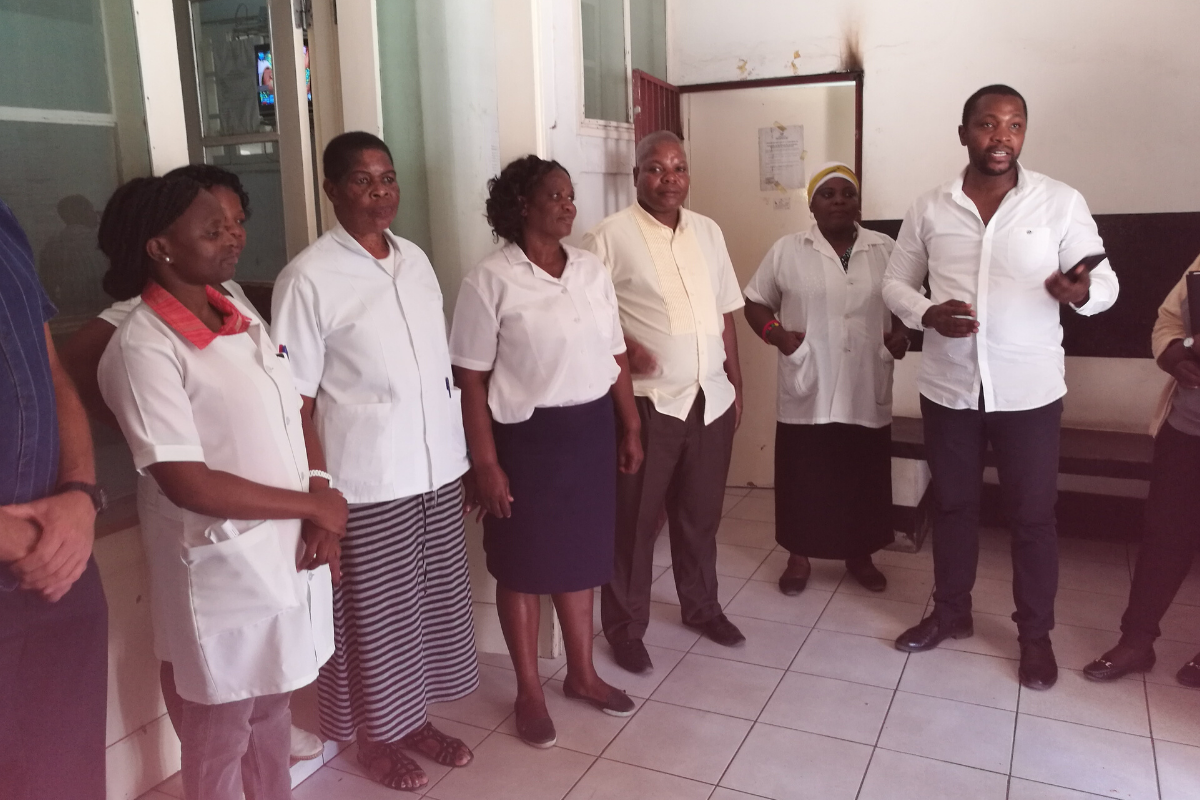
- In September 2018, Health Alliance International hosted the SMhINT Annual Meeting in Beira City, Mozambique. Roughly 32 individuals attended the meeting, with representation from all stakeholders engaged in the consortium, including the University of KwaZulu-Natal (UKZN), the University of Washington (UW), the Center for Operations Research Beira (CIOB), Muhimbili University of Health and Allied Sciences (Tanzania), Duke Global Health Institute, the Tanzanian Ministry of Health (MOH), the National Institute of Mental Health (NIMH), Health Alliance International (HAI), the Ministry of Health of Mozambique, and two fellows who are educators of psychology at the Catholic University of Mozambique (UCM).
- The Annual Meeting started with a warm welcome from the Mozambican team and a tour of three health facilities in Beira. On the following day, partners discussed project progress, revisited the RE-AIM indicators, and strategized methods to improve the costing and impact analysis developed in year one. On the third day of the meeting, the consortium met the Mozambican candidates, in which the trainees gave a ten-minute self-introduction. In this introduction, trainees described their research interests, outlined key personal objectives they wished to obtain from the learning opportunity, and worked with workshop participants to identify potential research topics to develop in the project.
- On the last day, the trainees and members engaged in a capacity-building workshop in which project leads introduced implementation science for global mental health. The grantee meeting concluded with an open discussion with trainees about their interests in implementation science in global mental health and final closing remarks.
Curriculum Development
In December 2018, the project team, under the leadership of Joao Manuel, a key implementer and representative from CIOB, drafted and distributed a comprehensive short-course curriculum to implement during the last six-months of the project period. The project curriculum contains 26 implementation science sessions, six course themes, and seven home-based activities to be administered over an 18-week timeframe. Table 1 (below) gives an overview of the six curriculum components and their tentative implementation dates.
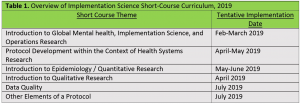
- Once the curriculum is finalized, trainees will have a draft protocol ready to submit to the Mozambican Human Subjects Review Board by September, 2019. Attached is the active 2019 IS Curriculum.
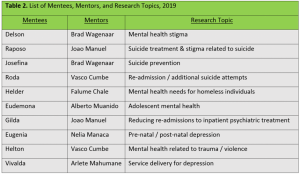
- In early January 2019, HAI Staff and Project Co-I Vasco Cumbe held a soft launch of the project curriculum among the ten project scholars. During this meeting, participants were given an overview of the course material, were matched with a mentor, and discussed overall project expectations and objectives. At the end of the meeting, staff coordinated a time to distribute academic supplies to the trainees. Course materials are distributed to trainees to ensure their learning is not hindered due to resource constraints. Prior to the official start of the short courses, in early Feb 2019, trainees received a backpack, notebook, laptop computer, flash drive, and a copy of the project curriculum. Table 2 (below) displays the final trainee list and associated mentors.
Launch of Short Courses & Materials Distribution
- On Feb 26th and Feb 28th 2019, Vasco Cumbe and Brad Wagenaar led the first short course section titled “Introduction to Global Mental health & Implementation Science”. The session provided an introduction to implementation science and covered common study designs for implementation science. For example, facilitators focused on highlighting that an implementation science study must consider an implementation strategy.
- The concept of an implementation strategy versus a health intervention was new to trainees and was discussed in detail. Classes were two hours long and were hosted at CIOB. All ten trainees attended the sessions and were actively engaged in the program content. In fact, one trainee, Gilda da Assunção Gotine, enthusiastically admitted that she would have to work to refine her research question so that it focused on an implementation strategy rather than testing a health intervention.
Integrating the SMhINT into the Catholic University of Mozambique-Initial Steps
HAI and CIOB have begun discussions with the Catholic University of Mozambique (UCM) to integrate the implementation science course into the Masters of Public Health curriculum at the University. The goal is to enable trainees to receive college credit upon completion of the project and encourage them to deepen their knowledge of public health.
Overall Accomplishments
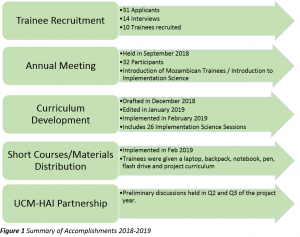
The HAI- Mozambique consortium completed a number of key activities during this reporting period. Figure 1 (below) provides a summary of accomplishments achieved during the project year.
What do you plan to do during the next reporting period to accomplish these goals?
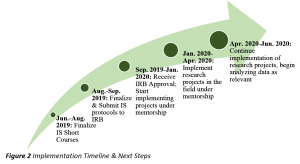
By the end of the 18-week learning experience, trainees will work closely with their mentors to draft and finalize their study protocol. By September 2019, trainees are expected to submit their protocol to the Mozambican Human Subjects Review Board for IRB approval. We anticipate that all trainees will receive IRB approval by December / January, 2019. Please see our project timeline below.